

Log in
The 10-Panel Urine Drug Test Card uses individual test strips incorporated into a single multi-panel device. After the urine specimen is applied according to the manufacturer's instructions, the specimen moves through the individual testing membranes.
Each panel contains reagents designed to react with a specific drug or its metabolite. The resulting lines are interpreted according to the test manufacturer's instructions.
A valid result requires the appearance of the appropriate Control (C) line. The presence or absence of the corresponding Test (T) line is then used to determine the preliminary screening result for each drug.
A preliminary positive result indicates that the drug concentration may be at or above the applicable screening cutoff. Such results should be confirmed using a more specific laboratory method when confirmation is required.
Cocaine is a powerful central nervous system stimulant derived from the coca plant. It can produce short-lasting stimulating effects and has a high potential for misuse and dependence.
Euphoria
Increased energy
Heightened alertness
Increased heart rate
Elevated blood pressure
Reduced appetite
Restlessness
Anxiety
Repeated misuse may contribute to cardiovascular problems, stroke, depression, and substance use disorder.
Coke, Blow, Snow, Crack, Rock, Flake, Yayo.
Cocaine metabolites are generally detectable in urine for approximately 2–4 days after use, although the detection period can vary.
Amphetamine is a central nervous system stimulant that is prescribed for certain medical conditions, including ADHD and narcolepsy. It increases activity in the brain and nervous system and can improve alertness and concentration.
Increased energy
Increased alertness
Improved concentration
Elevated mood
Increased heart rate
Reduced appetite
Restlessness
Difficulty sleeping
Misuse may result in dependence and cardiovascular or psychological complications.
Speed, Uppers, Bennies, Pep Pills, Dexies.
Amphetamine is generally detectable in urine for approximately 1–3 days after use.
Methamphetamine is a powerful synthetic central nervous system stimulant with a high potential for misuse and dependence. It can produce intense stimulation and increased energy.
Euphoria
Increased energy
Heightened alertness
Rapid heartbeat
Reduced appetite
Restlessness
Anxiety
Insomnia
Long-term misuse may contribute to severe physical and psychological health problems.
Meth, Crystal Meth, Crystal, Ice, Glass.
Methamphetamine is generally detectable in urine for approximately 2–4 days after use.
Marijuana is a psychoactive substance derived from the Cannabis sativa plant. Its primary psychoactive component is delta-9-tetrahydrocannabinol (THC).
Relaxation
Euphoria
Altered perception
Increased appetite
Dry mouth
Red eyes
Slower reaction time
Impaired coordination
Frequent or heavy use may affect memory, concentration, and psychological well-being.
Weed, Pot, Cannabis, Grass, Herb, Ganja, Mary Jane, Hash.
THC may be detectable in urine for approximately 3–30 days, depending on frequency of use and individual factors.
Methadone is a long-acting synthetic opioid used medically for pain management and as part of treatment for opioid use disorder. It can reduce opioid withdrawal symptoms and cravings when used under medical supervision.
Pain relief
Reduced opioid cravings
Reduced withdrawal symptoms
Relaxation
Drowsiness
Dizziness
Nausea
Slowed breathing
Improper use can result in dependence, respiratory depression, and overdose.
Methadone, Fizzies, Juice, Amidone, Methadose.
Methadone may generally be detectable in urine for approximately 3–7 days after use.
Opiates are naturally occurring opioid substances derived from the opium poppy, including morphine and codeine. They are used medically for pain relief but may also produce euphoric and sedative effects.
Pain relief
Euphoria
Relaxation
Drowsiness
Constricted pupils
Slowed breathing
Nausea
Constipation
Misuse may lead to tolerance, dependence, respiratory depression, and overdose.
Smack, Dope, H, Horse, Junk, Mud.
Opiates are generally detectable in urine for approximately 2–3 days, depending on the substance and frequency of use.
Phencyclidine (PCP) is a dissociative substance that can significantly alter perception, mood, behavior, and coordination. It was originally developed as an anesthetic but is no longer used medically.
Hallucinations
Confusion
Altered perception
Agitation
Numbness
Loss of coordination
Elevated blood pressure
Detachment from reality
Heavy use may result in severe psychological and neurological complications.
Angel Dust, Sherm, Wet, Rocket Fuel, Love Boat.
PCP may be detectable in urine for approximately 5–8 days, with longer detection possible in chronic users.
Barbiturates are central nervous system depressants that have been used medically for certain seizure disorders and other conditions. They can produce sedative effects but may also cause dependence and overdose when misused.
Drowsiness
Sedation
Relaxation
Slowed breathing
Poor coordination
Slurred speech
Dizziness
Confusion
Barbs, Downers, Reds, Blues, Yellow Jackets.
Barbiturates may be detectable in urine for approximately 2–15 days, depending on the specific substance and individual factors.
Benzodiazepines are prescription medications commonly used to treat anxiety, insomnia, certain seizures, and other conditions. They produce calming and sedative effects by reducing activity in the central nervous system.
Relaxation
Reduced anxiety
Drowsiness
Muscle relaxation
Slowed reflexes
Memory impairment
Poor coordination
Dizziness
Prolonged or inappropriate use may lead to tolerance and dependence.
Benzos, Xannies, Bars, Vallies, Tranks, Downers.
Benzodiazepines are generally detectable in urine for approximately 2–7 days, although some long-acting medications may remain detectable for longer.
Tricyclic Antidepressants (TCAs) are prescription medications primarily used to treat depression. Some are also used for chronic pain, nerve pain, and other medical conditions.
Improved mood
Drowsiness
Dry mouth
Blurred vision
Constipation
Dizziness
Increased heart rate
Changes in appetite
Excessive use or overdose can cause serious cardiovascular and neurological complications.
TCAs are prescription medications and generally do not have standardized street names.
Tricyclic antidepressants may generally be detectable in urine for approximately 2–7 days, depending on the specific medication, dosage, and individual metabolism.
The 10-Panel Urine Drug Test Card provides a convenient solution for simultaneous preliminary screening of 10 commonly monitored drugs using a single urine specimen. Its multi-panel design helps streamline the testing process while reducing the need for multiple individual drug tests.
By screening for Cocaine, Amphetamine, Methamphetamine, Marijuana, Methadone, Opiates, Phencyclidine, Barbiturates, Benzodiazepines, and Tricyclic Antidepressants, the test provides broad coverage for professional drug screening programs.
The convenient format is suitable for workplace testing, healthcare facilities, rehabilitation programs, occupational health services, correctional facilities, compliance monitoring, and forensic applications.
Important: The product information you provided does not specify the individual cutoff levels for these 10 panels, so I have intentionally not added numerical cutoffs. Those values should be taken from the manufacturer's package insert or product specification before publishing the product page.
The 10-Panel Urine Drug Test Card is a multi-drug urine screening device designed to provide convenient preliminary detection of 10 commonly monitored drugs using a single urine specimen. Its multi-panel format allows several drug classes to be screened simultaneously, making it a practical solution for routine and high-volume drug testing programs.
The test card is designed for simple and efficient urine drug screening, helping reduce the need for multiple individual drug tests. By testing several substances at the same time, it can help save time, simplify the screening process, and improve workflow efficiency.
This 10-panel configuration screens for Cocaine (COC), Amphetamine (AMP), Methamphetamine (mAMP), Marijuana (THC), Methadone (MTD), Opiates (OPI), Phencyclidine (PCP), Barbiturates (BAR), Benzodiazepines (BZO), and Tricyclic Antidepressants (TCA).
The compact test card format requires a urine specimen and provides an easy-to-read visual result for each tested drug panel. It is suitable for professional drug screening programs where multiple substances need to be evaluated using a single specimen.This product provides preliminary qualitative screening results only. Any preliminary positive result should be confirmed using an appropriate laboratory confirmation method such as Gas Chromatography–Mass Spectrometry (GC-MS) or Liquid Chromatography–Tandem Mass Spectrometry (LC-MS/MS) when confirmation is required.
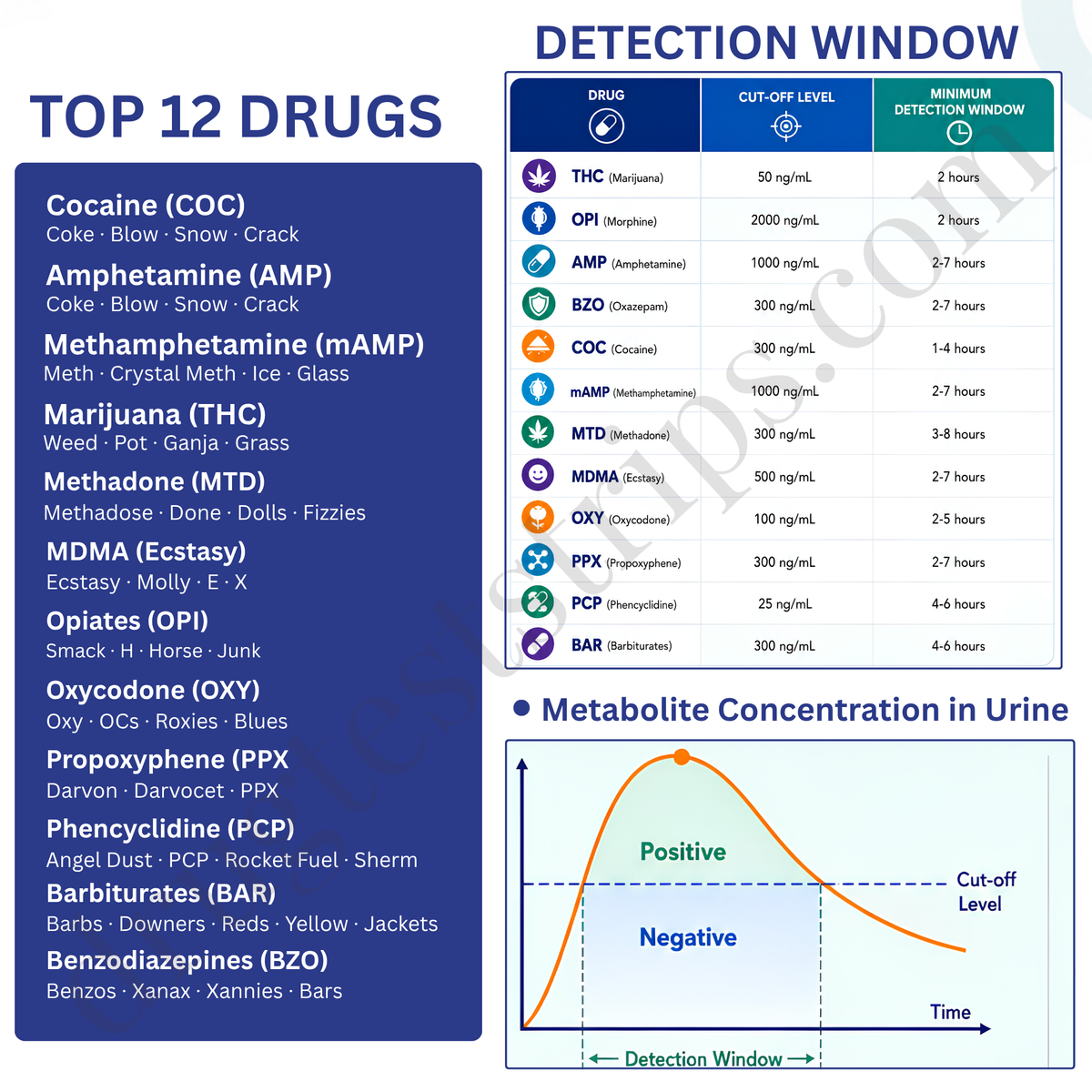
This 10-panel urine drug test card screens for:
Drug
Typical Detection Window
Cocaine (COC)
2–4 Days
Amphetamine (AMP)
1–3 Days
Methamphetamine (mAMP)
2–4 Days
Marijuana (THC)
3–30 Days
Methadone (MTD)
3–7 Days
Opiates (OPI)
2–3 Days
Phencyclidine (PCP)
5–8 Days
Barbiturates (BAR)
2–15 Days
Benzodiazepines (BZO)
2–7 Days*
Tricyclic Antidepressants (TCA)
2–7 Days
*Some long-acting benzodiazepines may remain detectable for a longer period.
This 10-panel urine drug test card screens for the following substances:
A colored line appears in both the Control (C) region and the Test (T) region for the corresponding drug panel. Even a faint Test (T) line should generally be interpreted as a negative result, provided the Control line is present.
Only one colored line appears in the Control (C) region, while no visible line appears in the corresponding Test (T) region. This indicates that the drug concentration may be at or above the applicable screening cutoff.
A preliminary positive result should be confirmed using a more specific laboratory method such as GC-MS or LC-MS/MS when confirmation is required.
If the Control (C) line does not appear, the result is invalid regardless of the Test (T) line. The test should be repeated using a new device and a fresh urine specimen.





10-Panel Urine Drug Test Card for Cocaine, Amphetamine, Methamphetamine, Marijuana, Methadone, Opiates, Phencyclidine, Barbiturates, Benzodiazepines, and Tricyclic Antidepressants | Abbott DOA-1104 25/Box

Sign up for updates from leading retailers


