Barbiturate (BAR) Drug Test Card 300 ng/mL | Abbott DBA-114 25/Box
Sku:DBA-114
Abbott
$48.00
/ per
In stock!
FREE SHIPPING
Spend to FREE SHIPPING
Key Features
Rapid one-step urine drug screening test
Detects Barbiturates (BAR)
Detects Secobarbital and related barbiturate metabolites
300 ng/mL screening cutoff
FDA Cleared
Configured to SAMHSA screening cutoff levels
Results available in approximately 5 minutes
Easy dip-and-read procedure
Approximately 95%–98% accuracy
No special laboratory equipment required
Individually sealed test cards
25 tests per box
Suitable for professional and home use
How the Test Works
The Barbiturate (BAR) Drug Test Card uses a lateral flow chromatographic immunoassay to detect barbiturates in human urine. Simply dip the absorbent end of the test card into the urine specimen for the recommended time, then place it on a clean, flat surface while the reaction develops. Results are typically available within 5 minutes.
This test provides a preliminary analytical result only. Any preliminary positive result should be confirmed using a laboratory confirmation method such as Gas Chromatography/Mass Spectrometry (GC-MS) or Liquid Chromatography–Mass Spectrometry (LC-MS/MS).
Package Contents
25 × Individually sealed Barbiturate (BAR) Drug Test Cards
Instructions for Use (IFU)
Barbiturates (BAR)
Detection Cutoff
300 ng/mL (Urine)
What are Barbiturates?
Barbiturates (BAR) are a class of central nervous system (CNS) depressant medications that slow brain activity and produce calming and sedative effects. Before the introduction of safer medications such as benzodiazepines, barbiturates were widely prescribed to treat anxiety, insomnia, seizure disorders, and to induce anesthesia during surgical procedures.
The Barbiturate (BAR) Drug Test Card is designed to detect barbiturates and their metabolites, including Secobarbital, in human urine at a 300 ng/mL screening cutoff. It provides fast and reliable preliminary screening results for workplace, clinical, forensic, and home drug testing programs
Medical Uses of Barbiturates
Although barbiturates are prescribed less frequently today, they still have important medical applications. Under the supervision of a healthcare professional, barbiturates may be used to:
Control certain types of seizures
Induce anesthesia before surgical procedures
Provide sedation before medical procedures
Treat severe insomnia in selected patients
Manage specific neurological conditions when other medications are not suitable
Some commonly prescribed barbiturates include:
Phenobarbital
Secobarbital (Seconal®)
Pentobarbital (Nembutal®)
Butalbital (commonly combined with pain medications)
Because these medication
can cause tolerance and dependence, they are generally prescribed for short-term use or when alternative treatments are not appropriate.
Barbiturate Misuse and Abuse
Barbiturates have a high potential for misuse because they produce feelings of relaxation, sedation, and euphoria when taken in excessive amounts. Misuse may involve taking higher doses than prescribed or using the medication without a prescription. Combining barbiturates with alcohol or opioids can significantly increase the risk of respiratory depression, overdose, and death.
Long-term misuse or abuse may lead to:
Physical dependence
Drug tolerance
Excessive drowsiness
Poor coordination
Slurred speech
Confusion and memory impairment
Respiratory depression
Increased risk of overdose
Due to these risks, barbiturate screening is commonly performed in workplace drug testing, rehabilitation programs, healthcare facilities, pain management clinics, and forensic investigations.
Common Effects
Relaxation
Sedation
Drowsiness
Reduced anxiety
Impaired coordination
Slower reaction time
Dizziness
Difficulty concentrating
Common Brand Names
Seconal® (Secobarbital)
Nembutal® (Pentobarbital)
Luminal® (Phenobarbital)
Fiorinal® (contains Butalbital)
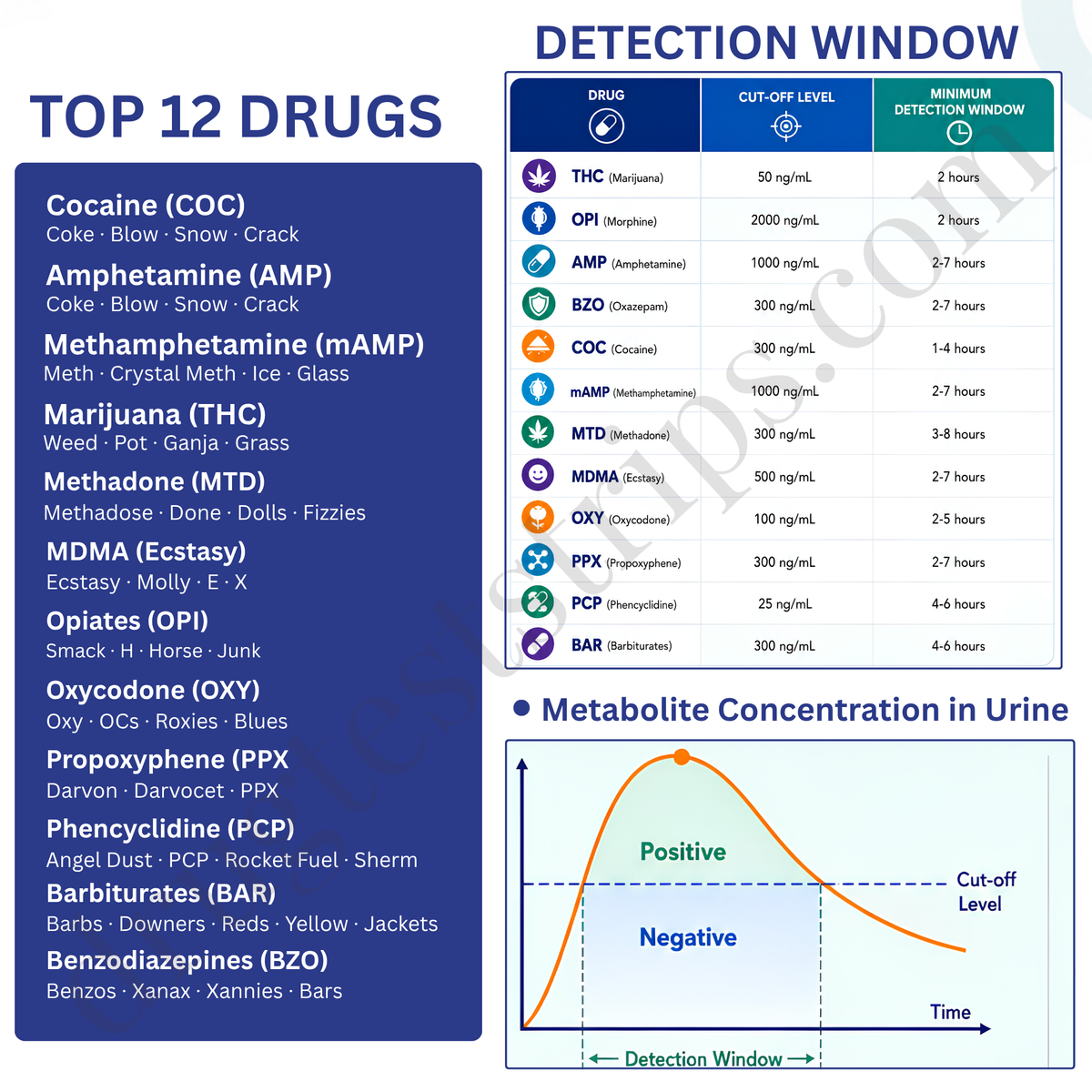
Detection Window
Barbiturates are generally detectable in urine for 2–7 days, depending on the specific medication used. Long-acting barbiturates, such as Phenobarbital, may remain detectable for up to 2–3 weeks after prolonged use.
Rapid Barbiturate (BAR) Urine Drug Test Card
The Barbiturate (BAR) Drug Test Card is a rapid, one-step urine drug screening test designed for the qualitative detection of Barbiturates (BAR) in human urine. Using a lateral flow chromatographic immunoassay, the test detects Secobarbital and other barbiturate metabolites at a 300 ng/mL cutoff concentration, delivering reliable preliminary screening results without the need for specialized laboratory equipment.
This easy-to-use single-panel drug test features a simple dip-and-read procedure and provides accurate preliminary results in approximately 5 minutes. The Barbiturate Drug Test Card is suitable for workplace drug testing, healthcare facilities, rehabilitation centers, pain management clinics, law enforcement agencies, and home drug screening.
Each box contains 25 individually packaged test cards for convenient single-use urine drug testing.
Barbiturates (BAR)
Drug
Typical Detection Window
Barbiturates (BAR)
2–7 Days (Long-acting barbiturates may be detectable for up to 2–3 weeks)
Drug
Cutoff Level
Barbiturates (BAR)
300 ng/mL
Negative Result
Two colored lines appear—one in the Control (C) region and one in the Test (T) region. Even a faint line in the Test (T) region should be interpreted as a negative result.
Preliminary Positive Result
Only one colored line appears in the Control (C) region, while no line appears in the Test (T) region. This indicates that barbiturates, including Secobarbital and related metabolites, may be present at or above the 300 ng/mL screening cutoff. Any preliminary positive result should be confirmed using Gas Chromatography/Mass Spectrometry (GC-MS) or Liquid Chromatography–Mass Spectrometry (LC-MS/MS).
Invalid Result
If no colored line appears in the Control (C) region, the test is invalid, regardless of whether a Test line appears. Repeat the test using a new test card.